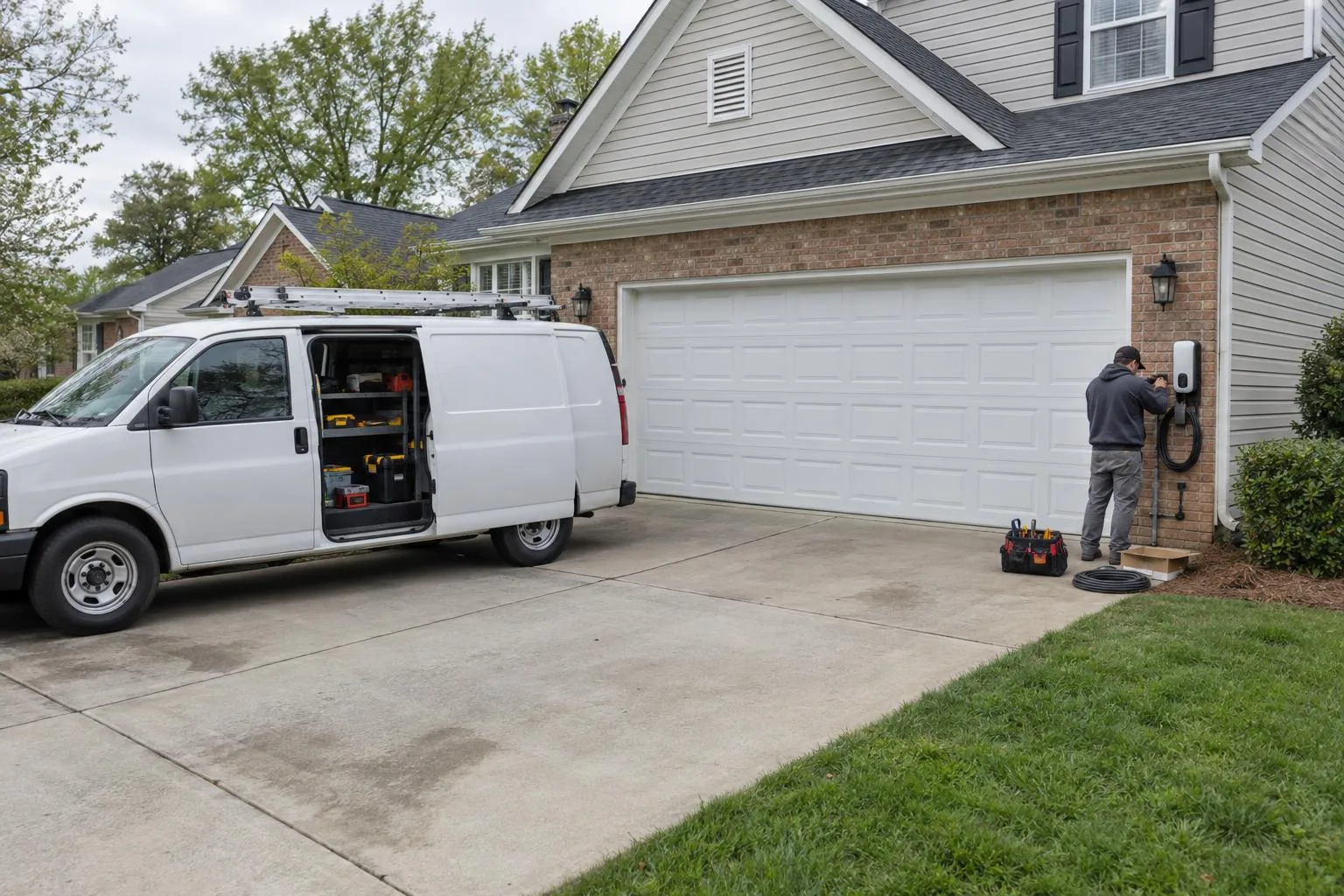
Tesla charger installation puts a Tesla Wall Connector on its own 60-amp circuit, so it charges at its full 48 amps. The Wall Connector adds up to 11.5 kW, mounts indoors or outdoors and sets up in the Tesla app over Wi-Fi. You can schedule charging, watch usage and get firmware updates automatically, and it works with most other EVs too.
Homes with a Tesla and a second EV can use the Universal Wall Connector, which keeps the Tesla plug and adds a J1772 adapter. Two Teslas can share one circuit with power sharing, so a two-Tesla home doesn't need a second circuit.
An EV panel upgrade makes room for a charger when your panel is full or your home runs on 100-amp service. Code treats EV charging as a continuous load, so a 48-amp charger needs a 60-amp circuit. Many homes built in the 1990s can't spare that much without work first.
We check your panel at the free estimate and tell you up front whether it needs a load calculation, load management or a service upgrade. When an upgrade is needed, we do it in the same visit as the charger install, with one crew. Panel work behind a charger also counts toward the Duke Energy credit.
Commercial EV charging installation brings Level 2 chargers to offices, retail lots, and apartment and condo properties across Charlotte. Every commercial job starts with the building's electrical service, since several chargers running at once add up to a large continuous load.
Load management lets several chargers share the capacity you already have, instead of a new circuit and a bigger service for each one. Tesla's Gen 3 Wall Connectors, for example, can link up to six units on one circuit. Your free written estimate puts each charger, circuit and permit on its own line, so you can compare it with any other bid.
Home Level 2 Charger Installation: Charlotte's Most Common EV Job
A Level 2 charger is the electric car charger installation most drivers call us for. A Level 2 charger runs on 240 volts and adds 10 to 30 miles of range per hour, compared with 2 to 5 on a standard wall outlet. We install it hardwired or on a plug, in the spot where the cable reaches your charge port cleanly.
Chargers we install include the Tesla Wall Connector, ChargePoint Home Flex, Emporia, JuiceBox, Wallbox, Ford and Rivian home chargers. If you haven't bought one yet, wait until after the panel check. The charger's amperage should match both your panel and your car's onboard charger.
NEMA 14-50 Outlet Installation and 240V Outlets
NEMA 14-50 outlet installation gives you a 240-volt plug in the garage for a plug-in charger or the mobile cord that came with your car. A plug-in setup lets you swap the charger later or take it with you when you move. Charging on a 14-50 outlet tops out around 40 amps, because chargers over 40 amps must be hardwired.
Owners often search "can I plug my EV into a dryer outlet" before they call us. Chargers over 40 amps must be hardwired and cannot use a dryer plug, and a shared outlet means unplugging the dryer every time you charge. A dedicated outlet or a hardwired charger avoids both problems.
Outdoor, Detached-Garage and Two-EV Installs
Outdoor and detached-garage installs need a longer wire run, and every part of that run has to be rated for the weather. We take the circuit through the wall, the attic, conduit or a trench under the driveway, whichever path is shortest and safe. The charger and its wiring are both rated for outdoor use on every driveway and carport install.
Two-EV homes have two choices. You can run a second circuit if the panel has room, or link two chargers with power sharing so both run off one circuit and split its power. Each car charges slower when both are plugged in at the same time.