
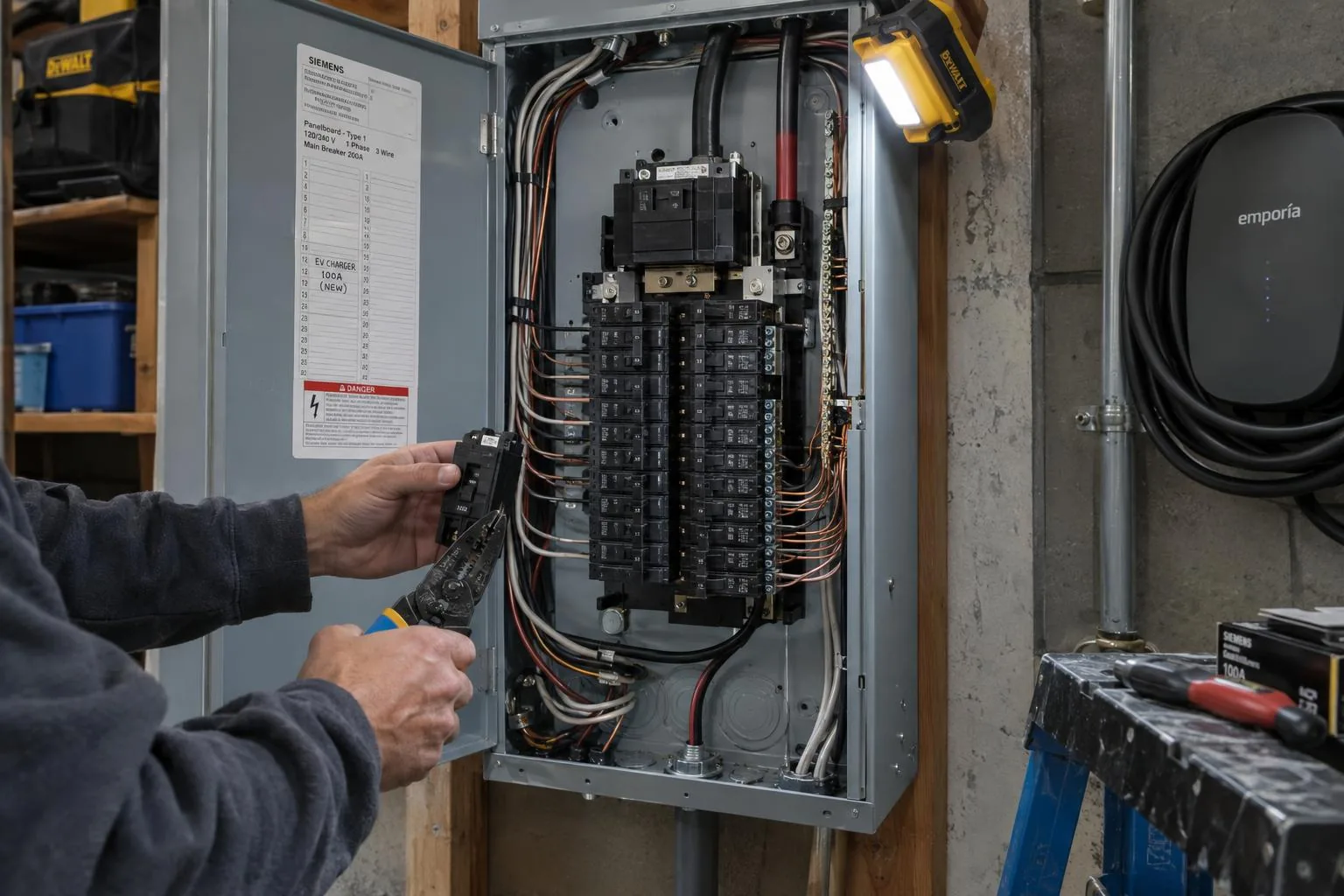
Electrician fitting a new breaker in a 200-amp panel labeled for an EV charger circuit, with an Emporia charger on the wall

EV Charger Panel Upgrade in Charlotte, NC: 200 Amp Service Upgrade for EV Charger and Load Calculation

Affordable EV Charger Panel Upgrade and Load Management for EV Charger Circuits in Charlotte, NC and Mecklenburg County

If your panel is full or your home runs on 100-amp service, EV Charger Installers of Charlotte handles the EV charger panel upgrade in Charlotte and across Mecklenburg County. We start with a load calculation, then add load management, a subpanel or a 200 amp service upgrade only when your home needs it. Whether you own a 1990s home in Mint Hill or an older house inside Charlotte, you end up with a panel that runs your charger without tripping the main.

Why homeowners choose us:

  • Licensed NC electricians on every charger install
  • Permits handled we pull the permit and meet the inspector
  • Duke-ready paperwork itemized invoices for the Charger Prep Credit
  • Free written estimates before any work is scheduled

We are licensed North Carolina electricians who have spent many years installing Level 2 and Tesla chargers. We do the panel work in the same visit as your charger installation, with one crew. You get a free written estimate and an itemized invoice built for the Duke Energy Charger Prep Credit, which covers panel upgrades and breakers.

Get a FREE EV Charger Installation Quote

What an EV Charger Panel Upgrade Involves in Charlotte, NC

An electrical panel upgrade for EV charger circuits is not always a new panel. Many homes can get an EV charger without panel upgrade work at all, and the right fix depends on what your service can spare. Every panel job we do works through the same pieces, from the cheapest fix to the biggest:

  • A load calculation adds up what your home already draws, so you know whether the charger fits before anyone buys parts.
  • Load management for EV charger circuits lowers the charger’s draw when the house is busy, which can avoid a service upgrade.
  • A new 60-amp breaker and circuit meets the EV charger panel requirements for a 48-amp charger, since code sizes the circuit at 125% of the charger rating.
  • Power sharing between two chargers lets two EVs run off one circuit, so a two-EV home doesn’t need two new circuits.
  • A subpanel for EV charger circuits puts breakers where you need them, such as a detached garage far from the main panel.
  • A 200 amp service upgrade for EV charger loads replaces an older 100-amp panel and service, the biggest cost swing in the job.
  • Duke Energy coordination handles the rare case where Duke’s own service feed to the house is too small for the upgrade.
  • The permit and inspection close out the job and keep you eligible for the Duke Energy credit.

When You Need an EV Charger Panel Upgrade in Charlotte

Do I Need a Panel Upgrade for an EV Charger? Signs to Watch For

  • The panel looks full with no open breaker slots. A full-looking panel does not always need replacing, and a load calculation shows what it can actually spare.
  • Breakers trip when the car charges while the house is busy. Left alone, the charger keeps cutting out and you wake up to a car that isn’t full.
  • Your home runs on 100-amp service and you want a 48-amp charger. A charger can work on a 100-amp panel in some homes, but only after a load calculation.
  • You bought the charger before anyone checked the panel and now it needs more than the panel can give. Buying first is the most common way homeowners end up with a charger their service can’t support.
  • A second EV is coming and both cars need a full charge overnight. Power sharing or load management can handle it without a second big circuit.
  • Another contractor quoted a full service upgrade without a load calculation. During the rush before the federal home charger credit ended, homeowners spent $3,000 to $8,000 more than needed, mostly on panel upgrades they didn’t need.

Planning an EV Charger Panel Upgrade for a Charlotte Home

A Charlotte panel upgrade comes down to four things: home age, 100-amp panels, the Duke Energy credit and the permit.

Load Management for EV Charger Circuits in Older Charlotte Homes

The median home was built in 1992 in Mint Hill, 1994 in Matthews and 1995 in Charlotte. Homes of that age are more likely to run on 100-amp service, and those are the homes most likely to need a panel upgrade. Most homes built in the last 20 years have a 200-amp panel with room to spare, and most South Charlotte homes only need a circuit added. In the older homes, load management can keep the charger on the existing panel.

Can You Install an EV Charger on a 100 Amp Panel?

In many Charlotte homes the answer is yes, after a load calculation. A 48-amp charger needs a 60-amp circuit, and an older 100-amp panel may not have that much to spare. Load management lowers the charger’s draw when the house is busy, so the charger can share the panel instead of forcing a 200 amp service upgrade. The trade-off is charging speed. A Level 2 charger adds 10 to 30 miles of range per hour, so a Waxhaw driver’s 46-mile round trip still comes back in about 2 to 5 hours at full speed.

The Duke Energy Credit Covers Panel Work

Duke Energy’s Charger Prep Credit pays up to $1,133 toward the wiring, panel upgrade and breakers behind a charger. You apply within 120 days of the invoice or the EV registration, whichever comes later. If Duke’s own service feed needs upgrading, that work falls under Duke’s Line Extension Plan and the credit does not cover it.

Permits for Panel Work in Mecklenburg County

Mecklenburg County Code Enforcement requires a permit and inspection for any new wiring or change to it, and a panel upgrade is no exception. An unpermitted install can cost you the Duke credit, so we file the permit on every job.

How Much Does an EV Charger Panel Upgrade Cost in Charlotte, NC?

An EV charger panel upgrade in Charlotte typically costs $800 to $2,000 on top of the charger installation. The charger installation itself runs $940 to $1,860, so a job with both usually lands between $1,740 and $3,860. The size of your current service, open breaker space and whether Duke has to upgrade its feed move the price. A load calculation often shows that load management or a new breaker is enough, and then there is no panel upgrade at all. The charger is bought separately, and the Duke Energy credit can pay back up to $1,133 of the wiring and panel work. For a full breakdown, see our EV charger installation cost page.

Our EV Charger Panel Upgrade Process in Charlotte, NC

Every panel job follows the same four steps, from the first call to the first full charge.

1. Free Estimate and Load Calculation

Your panel is the first thing we look at, because its free capacity decides the whole job. We run a load calculation, check your service size and breaker space and ask which EV you drive. You get a free written estimate that shows the smallest fix that works, whether that is load management, a new breaker, a subpanel or a 200 amp service upgrade.

2. Permit Filed

A panel upgrade changes the wiring that feeds your whole house, so the permit covers more than the charger circuit. We file the permit with the county office that serves your address. The fee goes on your invoice as its own line, which is how you pay for the permit the way Duke Energy requires. A permitted panel upgrade keeps you eligible for its credit.

3. Panel Upgrade and Charger Installation Day

A charger install with a new breaker or load management is usually done in one visit, taking 4 hours to a full day. A full 200 amp service upgrade takes longer, and power to the house is off while we work inside the panel. If Duke’s own feed needs upgrading, Duke handles that part under its Line Extension Plan. When the panel work is ours alone, we install the charger during the same visit, so you deal with one crew.

4. Inspection and First Charge

Your county electrical inspector checks the panel work and the charger circuit on a separate visit after the job is done. We confirm the charger runs at full speed without tripping anything and hand you the itemized invoice for your Duke Energy credit application.

We also handle Tesla charger installation for homes and commercial EV charging for businesses and apartment properties across Charlotte.

EV Panel and Service Upgrades FAQs: Charlotte, NC

Do I need a panel upgrade for an EV charger?

Plenty of Charlotte homes skip the panel upgrade. Most homes built in the last 20 years have a 200-amp panel with room for a 60-amp charger circuit. Older homes on 100-amp service are the most likely to need one, and a load calculation tells you for sure before you spend anything.

Can you install an EV charger on a 100 amp panel?

You can install an EV charger on a 100 amp panel when the load calculation shows enough spare capacity. Load management helps by lowering the charger's draw when the house is busy. If the panel has no room even with load management, a 200 amp service upgrade is the fix.

Can I get an EV charger without a panel upgrade?

Skipping the panel upgrade is possible in many homes. Load management or power sharing between two chargers can keep the load inside what your panel can carry. The load calculation at the free estimate shows which option fits your home.

What are the EV charger panel requirements?

Code treats EV charging as a continuous load, so the circuit is sized at 125% of the charger rating. A 48-amp charger needs a 60-amp circuit and a panel with enough spare capacity to carry it. Chargers over 40 amps must be hardwired rather than plugged into an outlet.

How much does an EV charger panel upgrade cost in Charlotte?

Panel upgrades for EV chargers in Charlotte typically cost $800 to $2,000 on top of the charger installation. The size of your current service and open breaker space move the price. The Duke Energy Charger Prep Credit can pay back up to $1,133 of the panel and wiring work.

Does the Duke Energy credit cover a panel upgrade?

The Duke Energy Charger Prep Credit covers panel upgrades and breakers as part of the wiring behind a charger, up to $1,133. It does not cover the charger itself, mounting or permit fees. If Duke's own service feed needs upgrading, that falls under Duke's Line Extension Plan instead.

How long does an EV charger panel upgrade take?

A charger install with a new breaker or load management usually takes 4 hours to a full day in one visit. A full 200 amp service upgrade takes longer, and any work on Duke's own feed is scheduled by Duke. The county inspection happens on a separate visit afterward.

EV Charger Installers of Charlotte serves Charlotte and Mecklenburg County, Union County, Cabarrus County and Iredell County, including Ballantyne, Concord, Cornelius, Davidson.

Get a Free EV Panel and Service Upgrades Quote in Charlotte, NC

(704) 741-6543 Get a Free Quote