
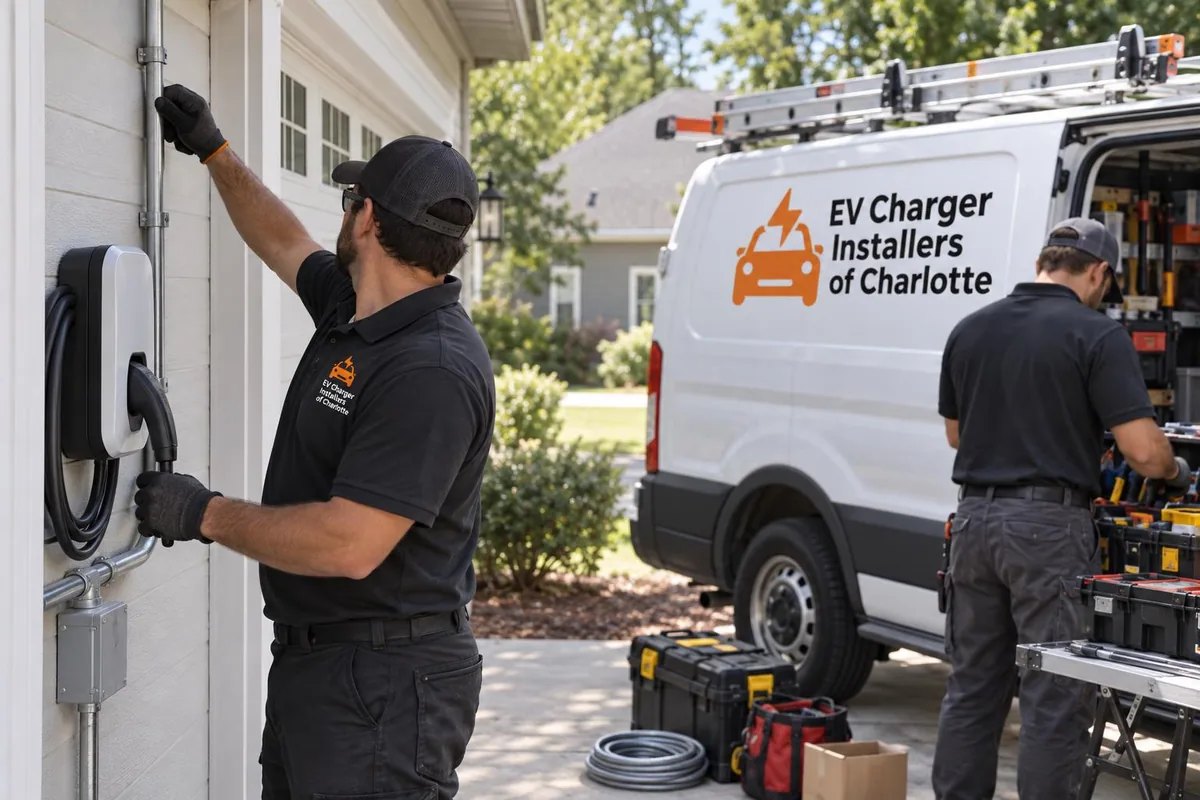
Two EV Charger Installers of Charlotte electricians at work, one fitting conduit beside a wall charger and one at the branded van

Duke Energy Charger Prep Credit in Charlotte, NC: Up to $1,133 Toward Your EV Charger Wiring

How the Duke Energy EV Charger Rebate Works for Charlotte Homeowners

EV Charger Installers of Charlotte helps you claim the Duke Energy EV charger rebate, Charlotte homeowners rely on when they add a home Level 2 unit. Duke calls it the Duke Energy Charger Prep Credit, and it pays up to $1,133 toward the wiring, outlet and panel work behind the charger. Duke customers in North Carolina who own their home and have an EV registered there qualify. Homes on the City of Concord's utility or a cooperative like Union Power are not Duke customers.

Why homeowners choose us:

  • Licensed NC electricians on every charger install
  • Permits handled we pull the permit and meet the inspector
  • Duke-ready paperwork itemized invoices for the Charger Prep Credit
  • Free written estimates before any work is scheduled

We are licensed North Carolina electricians who have spent many years installing Level 2 and Tesla chargers. We pull the permit on every install and hand you an itemized invoice formatted for the Duke Energy credit, with materials, labor and the permit fee on separate lines. You get a free written estimate first, so you know what the credit can cover before any work starts.

Get a FREE EV Charger Installation Quote

What the Duke Energy Charger Prep Credit Covers in Charlotte

The Duke Energy EV charger installation rebate covers the electrical work that gets your home ready for a charger, called make-ready work. The charger itself and the work of hanging it are yours to pay. Here is how Duke splits the costs:

Covered by the creditNot covered by the credit
Conduit, wiring and outlets supplying the charger, including a 240-volt outletThe EV charger hardware itself
Panel upgrades and breaker installationMounting and commissioning the charger
Labor for the covered electrical workPermits and permit fees
Wiring upgrades to support Level 2 or faster chargingService upgrades past the Duke meter
Duke’s own feed upgrade, when its Line Extension Plan applies

Who Qualifies for the Duke Energy Credit in Charlotte and Mecklenburg County

The list of rules is short, and it is the same statewide, so the EV charger rebate NC homeowners get in Raleigh works the same way in Charlotte. You qualify when every one of these is true:

Duke Energy EV Charger Rebate North Carolina Rules

  • You are a Duke Energy customer in North Carolina and the primary account holder or an authorized user files the application.
  • You own the home at the Duke service address, since renters and condo owners who don’t own the property are not eligible.
  • A fully electric or plug-in hybrid EV is registered to your Duke account address, and you get one rebate per EV registered there.
  • A licensed electrician did the work, or an employee of a licensed electrical contractor.
  • The work was permitted, with the permit pulled and paid for through your local permitting office.
  • The charger connects to your home’s panel, and it does not have to be in the garage.

Mecklenburg County Code Enforcement permits and inspects every EV circuit in Charlotte, so the permit rule is easy to meet with a licensed electrician.

Two Ways to Claim the Duke Energy Credit in Charlotte

Duke gives you two routes to the same credit. The right one depends on whether you have already picked your electrician.

Customer Credit Option: Duke Energy EV Charger Reimbursement by Check

You choose your own electrician, pay the invoice and then apply to Duke with your documents. Duke reviews the application, emails a confirmation and mails a check for up to $1,133 within 30 days through its vendor Blackhawk. This is the route you use when you hire us, and it also works for charger prep work you finished in the last four months.

Contractor Credit Option: A Duke Energy EV Charger Contractor Discount

Duke helps you choose an electrical contractor, and the credit shows up as a discount on the contractor’s final bill for the qualifying work. You never wait on a check, but you work with the contractor Duke helps you pick. If you want to choose your own Duke Energy EV charger contractor, the customer option is the one to use.

The Paperwork Behind a Charlotte Duke Energy Credit Application

Your reimbursement is only as fast as the paperwork behind it. An invoice missing a required line can hold an application up. Duke asks for four things:

  • A completed application that agrees to Duke’s terms and is filled out in full.
  • A copy of your EV registration showing the vehicle at your Duke account address.
  • A detailed, itemized, paid invoice with the contractor’s name, address and phone number, materials and labor as separate items, and the permit cost on its own line.
  • A copy of the approved permit from your municipal or county permitting office.

Every invoice we write follows that format, so your application goes in complete the first time. If you lose it, ask us for a duplicate, the same fix Duke suggests.

Checking Your Duke Energy EV Charger Rebate Status

After you apply, Duke reviews the application and emails you a confirmation. You can track its progress online through Duke’s application page until the check arrives. The check is issued within 30 days. You can apply as soon as the work is done and paid and the permit is approved.

How Charlotte Homeowners Lose the Duke Energy Credit

The credit can slip away on paperwork and timing, not just on the work. These are the ways homeowners lose it:

  • Waiting past 120 days after the later of the latest invoice or the EV registration, since older work is not eligible.
  • Work finished before May 19, 2022, which does not qualify at all.
  • An unpermitted install, which disqualifies the credit and can cause trouble with an insurance claim.
  • Renting or not owning the property, since the applicant must own the home at the service address.
  • An invoice that lumps everything together, because Duke needs materials, labor and the permit fee as separate lines.
  • A Duke service feed that is too small, a rare case where Duke’s Line Extension Plan applies and the credit does not cover that cost.

What Charlotte Homeowners Still Pay After the Duke Energy Credit

Is Duke Energy EV Charger Installation Free

No, the Duke credit does not make the install free. Some contractors tell homeowners the credit makes the install free, and that leaves out three real costs. You still pay for the charger itself, mounting it and the permit fee. A Level 2 charger runs $685 to $1,950, and a standard installation in Charlotte runs $940 to $1,860 before the credit. The credit pays up to $1,133 back on the wiring, outlet and panel part of that. For the full breakdown, see our EV charger installation cost page. If your panel needs work, the credit also covers the EV charger panel upgrade work.

Duke also offers the EV Overnight Advantage rate, which discounts charging from 11 p.m. to 5 a.m., so a home EV charger rebate is not the only saving.

Duke Energy Charger Prep Credit FAQs: Charlotte, NC

Does my charger have to be in my garage?

Your charger does not have to be in the garage to qualify for the Duke Energy Charger Prep Credit. Duke only requires that it connects to your home's electrical panel. A driveway, carport or detached garage install qualifies the same way.

What if I got a charger installed more than 120 days ago?

A charger installed more than 120 days ago is not eligible for the Duke Energy Charger Prep Credit. The window runs from the later of your latest invoice date or your EV registration date. Apply as soon as the work is done and the permit is approved.

What if I live in an apartment, condo or rental property?

You need to own the property to get the Duke Energy Charger Prep Credit, so renters and condo residents who don't own their unit are not eligible. Duke refers property managers to its commercial Charger Prep Credit instead. Our commercial EV charging page covers that program.

What if I want to install a charger but do not own an EV?

You must own or lease an EV to get the Duke Energy Charger Prep Credit. The vehicle has to be registered to your Duke account address. A fully electric car or a plug-in hybrid both count.

Does the Duke Energy credit cover the charger itself?

Duke's Charger Prep Credit does not cover the charger itself. It pays toward the conduit, wiring, outlet, panel upgrade and breaker behind the charger, plus the labor for that work. Mounting, commissioning and permit fees are not covered.

How long does the Duke Energy credit take to arrive?

Your credit arrives as a check in the mail within 30 days, sent by Duke's vendor Blackhawk. Duke emails a confirmation after it reviews your application. You can track the application online in the meantime.

Does my electrician have to be licensed?

Your electrician must be licensed for the Duke Energy Charger Prep Credit, or be an employee of a licensed electrical contractor. A manufacturer's installer certification does not replace a North Carolina electrical license.

Can I get the Duke Energy credit for two EVs?

You can claim one Duke Energy Charger Prep Credit per EV registered to your address. A household with two registered EVs can apply for each, since Duke allows one rebate per EV registered to the address.

EV Charger Installers of Charlotte serves Charlotte and Mecklenburg County, Union County, Cabarrus County and Iredell County, including Ballantyne, Concord, Cornelius, Davidson.

Get a Free Duke Energy Charger Prep Credit Quote in Charlotte, NC

(704) 741-6543 Get a Free Quote